Why Was Chris Dawson Convicted When No One Has Been Charged Over Bronwyn Winfield’s Death?
A Coffee & Crime AU Evidence Comparison

When two Australian women disappear without a trace, the similarities can seem striking.
Lynette Simms vanished from Sydney’s northern beaches in 1982. Bronwyn Winfield disappeared from Lennox Head in 1993. Neither woman has ever been found. Both cases involved marital breakdown, a family home, and decades of unanswered questions.
Yet the legal outcomes could not be more different.
In 2022, Chris Dawson was convicted of murdering Lynette Simms. In Bronwyn Winfield’s case, no person has been charged or convicted, and Jon Winfield has consistently denied any involvement in her disappearance and death.
So what is the difference?
This article looks at the publicly known evidence in both cases and explains why one resulted in a conviction while the other has not.
The Key Legal Difference

Before comparing the evidence, one distinction is essential:
Chris Dawson was found guilty in a criminal court beyond reasonable doubt.
Jon Winfield has never been charged. Public discussion concerns suspicion and investigation, not proven guilt.
That difference must remain at the centre of any comparison.
The Similarities That Often Lead People to Compare the Cases
These similarities explain why the two cases are frequently discussed together.
The Evidence in the Chris Dawson Case

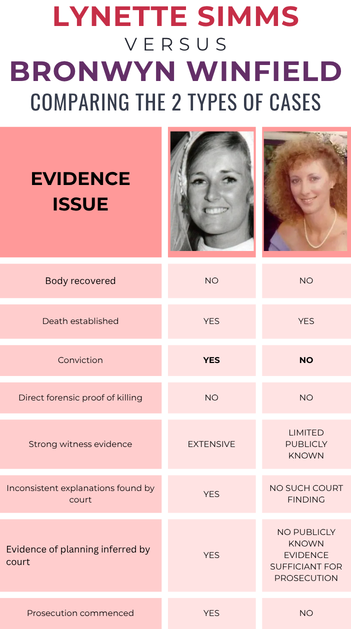
The prosecution case against Chris Dawson was largely circumstantial. There was no body, no confession, and no direct forensic evidence proving how Lynette died.
The court relied on the combined weight of many pieces of evidence, including:
evidence that Lynette had not voluntarily abandoned her children,
evidence of serious marital problems,
evidence of Dawson’s relationship with a teenage student,
evidence that he wanted Lynette removed from the family home,
inconsistent or misleading explanations about her disappearance,
and witness testimony gathered over many years.
The trial judge concluded that these circumstances, taken together, proved beyond reasonable doubt that Chris Dawson killed Lynette.
The Evidence in the Bronwyn Winfield Case

Publicly known evidence in Bronwyn’s case includes:
Bronwyn disappeared on the night of 16 May 1993,
she was last known to be at the family home on Sandstone Crescent,
her marriage had broken down,
there was conflict surrounding the family home,
and she was not reported missing until 27 May 1993, eleven days later.
Police later treated the case as a suspected homicide, and a coronial inquest found that Bronwyn had died on or about the time she disappeared.
However, no body has been found, and no person has been convicted of causing her death.
The Crucial Difference: Suspicion vs Proof

This is the point where the two cases separate.
In the Dawson case, the court accepted not only that Lynette was dead, but that Chris Dawson was the person responsible.
In Bronwyn’s case, the coroner found that she had died, but the publicly known evidence has not been sufficient to prove beyond reasonable doubt that a particular person caused her death.
A criminal prosecution requires evidence capable of persuading a jury. Suspicion, even strong suspicion, is not enough.
Why “No Body” Did Not Prevent a Conviction in the Dawson Case

Australian courts can convict a person of murder even when a body has never been found. The prosecution must still prove three things:
the person is dead,
the death was caused unlawfully,
and the accused was responsible.
In the Dawson case, the court found all three elements proved.
In Bronwyn’s case, the first element has been established through the coronial finding, but the third element has not been established in court.
A Comparison of the Publicly Known Evidence

The Role of the Director of Public Prosecutions

After the 2002 coronial inquest, the matter was considered by the NSW Director of Public Prosecutions. Prosecutors ultimately determined that there was insufficient evidence to proceed with a criminal prosecution.
That decision is one of the clearest indicators that the available evidence did not meet the threshold required for a murder trial.
Why the Comparison Still Matters

Comparing these cases is not about declaring guilt. It is about understanding how criminal courts evaluate evidence.
The Dawson case demonstrates that a murder conviction can be obtained without a body when the circumstantial evidence is sufficiently strong and consistent.
The Winfield case demonstrates the opposite reality: a person may be missing, a coroner may conclude they died, and investigators may suspect homicide, yet the evidence may still fall short of what the law requires for prosecution.
The Unanswered Question

More than thirty years after Bronwyn Winfield disappeared, one question remains unanswered:
What happened on the night of 16 May 1993?
Until that question is answered, Bronwyn’s family continues to live with uncertainty, and her case remains one of Australia’s enduring unsolved disappearances.
Sources
NSW Police Force – Bronwyn Winfield reward appeal
Australian Missing Persons Register – Bronwyn Joy Winfield
NSW Coroners Court reporting on the 2002 inquest
Supreme Court of New South Wales judgment in R v Dawson (No 7) [2022] NSWSC 1131
Major Australian news reporting on the Dawson conviction and the Winfield investigation
This article is intended for educational and documentary purposes and is based on publicly available records, court judgments, coronial findings, and police statements.

